
Ending the post code lottery in care?
Local social care spending across England does not reflect different levels of need - and reforms announced last week make only a slow start at putting that right

Spending on the NHS varies across England on the basis of need; spending on adult social care does not. Addressing this disparity will be essential to build a National Care Service.
New figures tell us just how much local care expenditure deviates from underlying spending pressures. The numbers are derived from the multi-year local government finance settlement published last week, which includes a new formula of relative need in adult social care. This reveals the share of national adult care spending each area would see if their expenditure was proportionate to their spending need.
CHART: In 2024/25 there was wide divergence between actual care spending and the spending implied by the government’s new relative needs formula
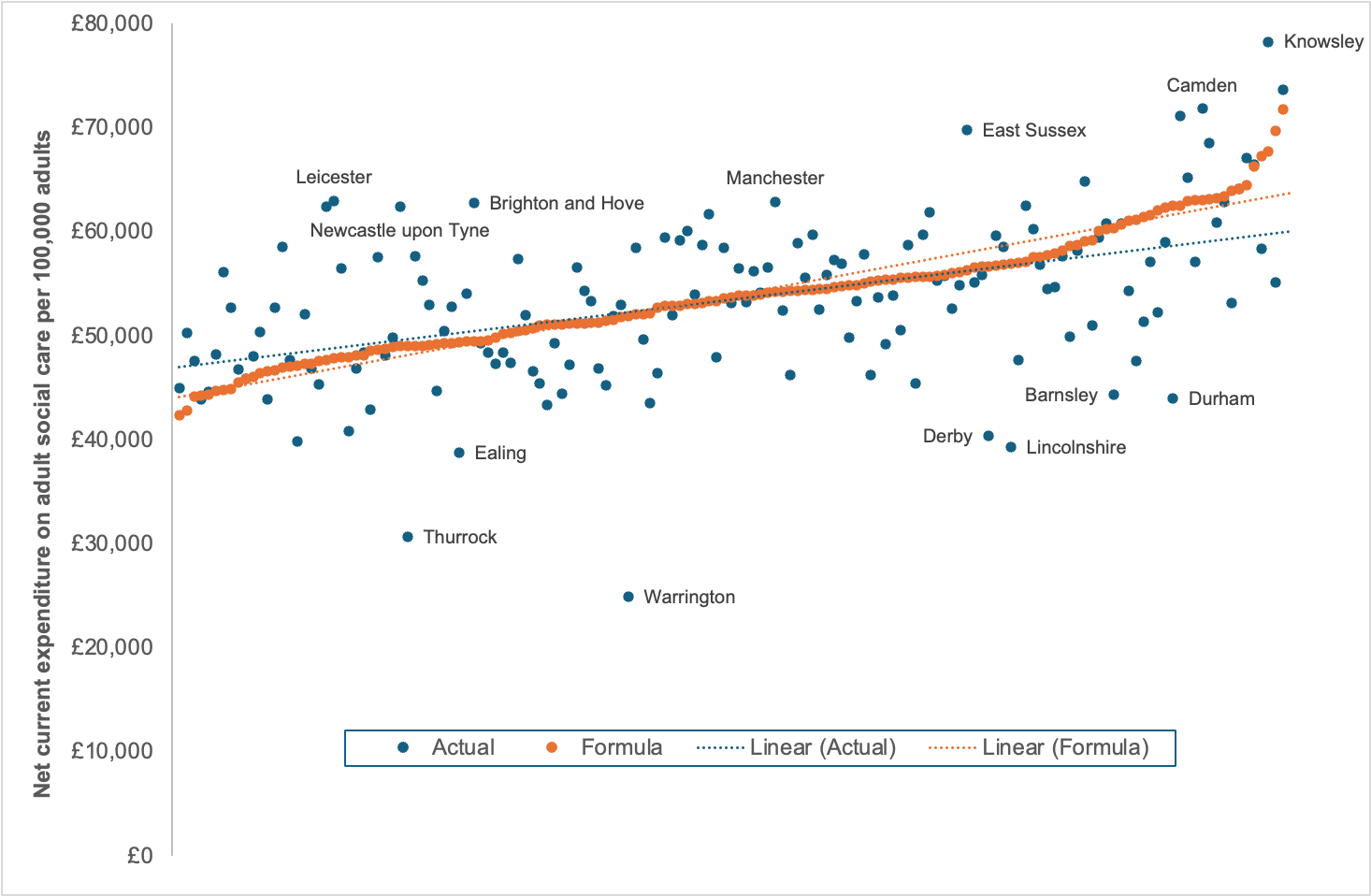
There are two important take-aways:
On average, areas with lower needs spend ‘too much’ and areas with higher needs spend ‘too little’. This is illustrated by the slopes of the two dotted trend-lines. The slope produced by the needs-based formula is steeper than the one for actual 2024/24 spending. The government is hoping to change this with its ‘fair funding’ reforms to local government finance, of which this new needs-based formula is a part. These measures will equalise overall local authority ‘spending power’, taking account of spending need and revenue raising capacity.
But the average is less important than the deviation. Spending for many individual councils is nowhere near the level indicated by the new formula. 28 councils spent at least 10% more than their needs-based allocation and 31 spent at least 10% less. The councils with the most ground to make up are Warrington, Thurrock, Lincolnshire, Durham, Derby, Barnsley, Southwark, Ealing and Westminster.
Where there is significant ‘over-spending’ or ‘under-spending’ now, convergence towards the spending implied by the national formula is required if the government is serious about building a National Care Service. Otherwise people with similar needs will continue to receive wildly different outcomes, based on where they live.
New government reforms only try to close the gap a bit
In the summer ministers announced that every council would be set a ‘notional allocation’ for adult social care to act as a reference point for their decisions on spending (see my previous post). If social care departments are spending below these allocations officials from the DHSC and CQC will want to know why.
You might think that the ‘notional allocation’ for each authority would be generated straightforwardly by the new relative needs formula. The government could say how much it wants spent on English adult care each year, and then tell each council their allocation of this sum according to their share of spending need.
But ministers have chosen a different path. Last week they announced a much more complicated system which will only lead to very slow convergence towards needs-based spending. This is because the new notional allocations ignore current levels of care spending and only tell councils how much new money they will be expected to spend each year.
Each local authority will be expected to increase spending on adult care by at least inflation even if they are spending a lot more than their ‘fair share’ under the relative needs formula. After that, new money designated for social care will be divided-up in line with the needs-based formula.
This approach - of allocating new money using a formula but ignoring historic spending - is how the Barnett Formula divides money between the four nations. It is also how local government finance has operated in recent years. But it is not how money is allocated to the NHS – and it is not how the rest of local government funding will work following next year’s reforms.
So why are ministers setting the ‘notional’ allocations for adult social care without reference to overall need? There are a few likely reasons:
This is mainly a scheme to ensure that new money from DHSC gets spent on social care. Ministers have said an extra £4.6bn should be spent on social care by 2028/29 and have created these arrangements to make this happen. Equalising local care spending relative to need is not the priority.
Ministers don’t want real cuts anywhere. Today’s ‘over-spenders’ will still be required to raise spending in line with inflation. Convergence is only to happen by others catching-up, as England-wide spending rises by more than inflation.
Low-spenders are too far off to converge quickly. DHSC ministers and officials probably concluded it would be counter-productive to set allocations for care that some authorities could not possibly reach within three years. They have set targets they think everyone can achieve.
There will still be some convergence in care spending. The DHSC notional allocations will drive this to a degree, by influencing how new money is spent. And the broader reforms to council spending power will create space for many low-spenders to catch-up.
But progress will be slow.
I can’t help thinking that it would be simpler and faster for the government to just tell councils how much they should be spending, if money followed need. It is a missed opportunity to create in shadow form the financial architecture that a National Care Service will need.
Once again egalitarian social policy is shown to be inherently centralist, requiring the central state to mobilise resources, determine need then allocate accordingly. Localism, if it means anything, has to accommodate variation and hence inequality. Fabians have recognised this tension since Bernard Shaw. Yet, recently, the society seems to have been echoing localist rhetoric, to the detriment of coherent and progressive policy, as you demonstrate here, Andy.
To what extent, Andrew, do you think that the Fair Funding strategy is meant to head off the implications of the litigation brought by the Information Commissioner and Access Social Care regarding the opaqueness of the funding formula for ASC in the first place?